
Research Interests
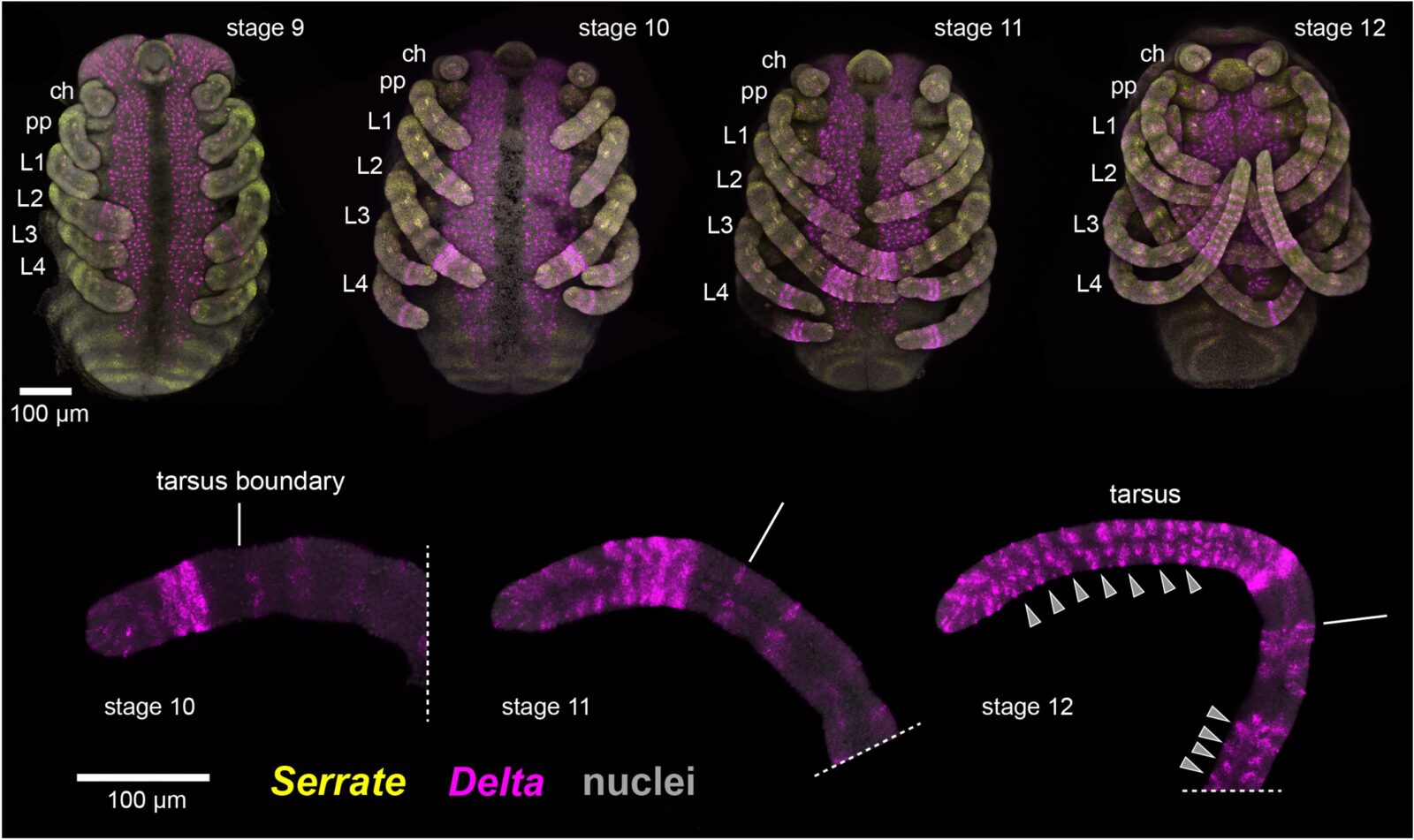
Prehensile legs have evolved multiple times in the arthropod tree of life, but their developmental genetic basis has never been explored. In Opiliones (daddy longlegs), the prehensile leg is established by sequential addition of repeated units called tarsomeres, the articles of the tarsus which confer exceptional flexibility to the Opiliones leg. The number of tarsomeres varies from one leg pair to the next and correlates positively with leg length, suggesting that differential growth underlies the number of tarsomeres formed on each leg. Using Phalangium opilio as a model system, I am investigating how these tarsomeres are generated and how the number of tarsomeres changes in Opiliones, through gene expression surveys and gene silencing experiments.
What made you choose this program at UW–Madison?
I began working in Sharma lab as a research technician while getting my undergraduate degree here at UW–Madison and realized how much I enjoyed working with embryos and learning how they developed. I chose this program because it offered me the opportunity to continue to learn about developmental genetics, while gaining research experience with transferable technical skills.
Education
BS, Biology, UW–Madison, 2024